representing modern reality in literature
February 6, 2026
mimesis, one of the best books i read in 2025, is primarily about the representation of reality and its evolution in literature over time. one can take an array of interpretations from this, but primarily either 1) the way we perceive society and others has changed as a function of our evolving brains and changes in our collective styles of writing reflect this or 2) writing acts as a technology which instructs us in new ways of seeing the world. note that “our evolving brains” does not necessarily mean genetic change but rather adaptations to cope with the increasing complexities of life. i fall more toward the former, though i find writing-as-a-technology fascinating.
life in the modern age with buzzing phones, pings, lights, notifications, and the endless scroll can be characterized as one of distraction. the stream of consciousness interrupted by sandbars, eddies, twists, and bends; it is much more difficult to experience a continuous flow of time with one’s thoughts even away from a screen – many may be listening to music or an audiobook while preoccupied with another task. as a practical example, my outdoor runs are done without music; when i bring earbuds with me i fin that i cannot think consistently about the day to come and get distracted by lyrics and rhythm. as an aside, there are almost no movies which accurately portray the intrusion of tech into our lives – if there were, the audience would likely find the characters’ constant checking distracting.
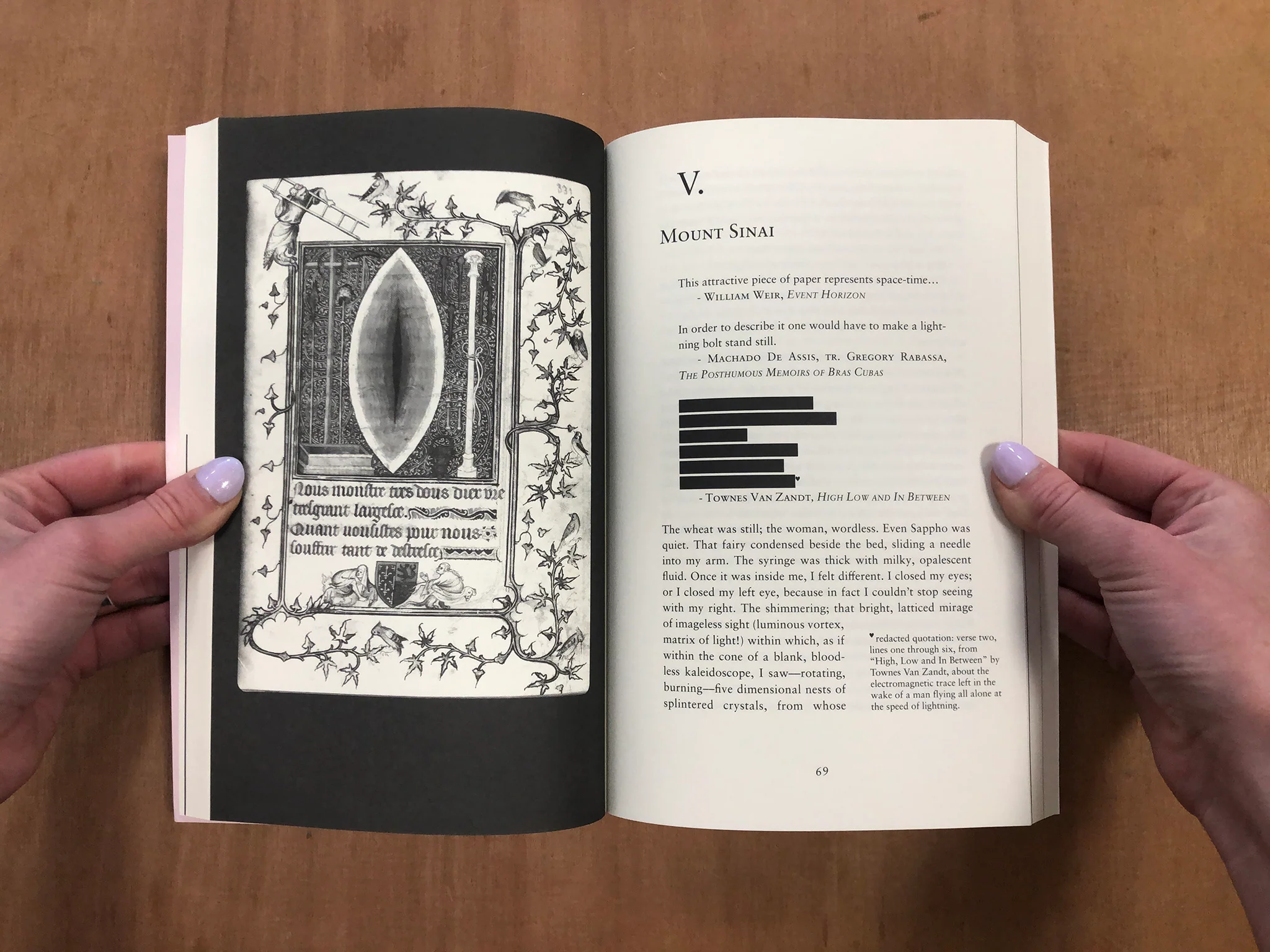
there are few authors who accurately display these aborted thoughts and constant asides. most recently, the fifth wound made an attempt; there is a cohesive narrative over which text messages and song lyrics are laid which provide emotional context to the reader. this strategy primarily works as a first-person limited or third-person omniscient as any exposure to these distractions necessarily requires that the reader enter the mind of the subject. however, this novel is autofiction which has begun to fall out of fashion in the literary scene – i’d like to see a novel which uses these strategies in another setting to see if they hold up. one would hope that autofiction is not the only genre which can handle these demands.
another option which has yet to be explored is the fourth-person view (really, better phrased as unified-plural, though more difficult on the tongue). social media (really, any mass media) allows a collective view of events and trends which then solicits mob reaction. if one has a bad opinion on the internet, a collective of individual thinkers (who happen to all believe and say similar things) appear to correct this defect. if there is a current ill in the world, a mass exists to observe it. thus a perspective composed of we and us (and chat) may capture the mass psychosis we all find ourselves in, perhaps with individual opinions appearing as virtual particles to exemplify group behavior. the goon squad is one such group behavior with individual members selected, though this is more of an ethnographic view. perfection, by vincenzo latronico, does not explicitly use this method, but contains a clinical observation of a couple captured by the idea of a larger lifestyle which they attempt to live up to, driven by the demands and ideal life shown to them by instagram. the anonymity of this couple allows them to be virtual stand-ins for this larger collective of soulless yuppies; there is a rewriting of this novel which would allow it to be written in terms of “we” and “us”, the continuous couple broken into instances of urbane yuppies without much change.
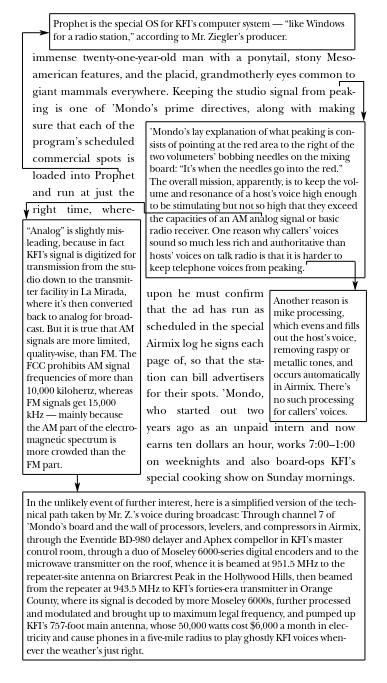
a work of nonfiction which performs these distractions particularly well is david foster wallace’s host, detailing the operations of a talk show on the pre-social media radio, adorned with footnotes which are graphically drawn originating from their trigger phrases. such a setup necessarily distracts the reader by causing them to jump back and forth between the main stream of consciousness and its individual tributaries, much as a stream of notifications and tweets shapes readers’ trains of thought, by doing so, such a method also makes clear the break from history our current mode of seeing is. host is a wonderful essay and its ability to cause the reader to leap between weakly connected thoughts exemplifies these differences from traditional fiction. this is the same for many participating in the world under modern pressures.
if literature is to accurately portray the perception of reality it must contend with the infiltration of distraction into every part of our lives. while some autofiction has attempted to do so, it seems an unexplored avenue so far for both the accurate imitation of readers’ lives and a critique of the time these constant distractions consume. as well, a reminder that many of us now, inadvertently or not, act on the behalf of a larger audience which seeks to enact its reactions on the world. a better writer than me ought to make this happen.