against optimization
January 20, 2026
the rate at which we flow through life is equal for all; what differs between people is the amount of distress1 they feel at this passage. optimization2 of one’s circumstances to reduce time and effort spent on tasks is many people’s coping mechanisms for this distress. while a general orientation and drive toward things which makes one more fulfilled3 is good, there is an tendency4 to reduce time on some seemingly unnecessary tasks, which may be a mistake.
some tasks require a pain period
at the beginning of every year, a subsection of the population resolves to begin exercising, often in the form of running. for this group, which has likely been sedentary up to this arbitrary point, a member is likely to hit the wall of an untrained cardiovascular system. this is quite the painful experience and therefore many of these resolutions fail. however, if the group were to push through the pain for approximately one month5, they would find that their lungs have adjusted to this new mode of operation such that they can achieve their goals.
the above is true for many achievements. though some look back fondly on college due to the ability to socialize and grow independently with one’s age group, these rosy memories obscure the four years of all-nighters and high-stakes finals6. it is also true of one’s early career, learning to drive, and so on. if one is only concerned with minimizing the present amount of time they spend on tasks they dislike, they may forgo more fulfilling opportunities7.
pain is a signal
it is rare that one completely knows their own preferences; rather, they only know of the set that they’ve explored, which are oftentimes determined by their formative years. a common example is a dietary preference toward dairy, bread, and meat8 due to the fact that roasting vegetables in the oven seems to have been discovered by millenials in 2011 in the united states. it could genuinely be the case that one does not enjoy vegetables, but they will not know for sure unless they subject themselves to the prospect of feeling a minor pain.
if one would truly like to maximize the amount of pleasure they can feel, the amount of pain they must be willing to put themselves through is non-zero. as pain itself informs the preference-space of people. as one moves through the world, this pain gives the subject an idea of what they should orient themselves toward. otherwise, we would retain all the same likes and dislikes as when we were born9.
optimization becomes an end goal in itself
this is the basic application of goodhart’s law, in which teaching becomes teaching to the test, and so on. in lifestyle, this tendency becomes insidious – time saved is an easy metric to measure, moreso than “utility”. and what exactly are these saved moments being used for? time with loved ones, fulfilling experience, a walk in the park? no! more often than not, these now become interstitial times between one event and the next10 now consumed by more trite experience which will be forgotten.
furthermore, interstitial time is a good in itself which allows us to ponder and reflect sporadically11. we are accustomed to being at hand, in effect disposed to the task we are enacting and otherwise engaged in the world. however, these times break an illusion12 and remind us that we are independent agents who may act upon the world in accordance with our desires. shaving off moments here and there turns us all into tools.
a radical discomfort
my apartment is notoriously inhospitable. during the summer, i usually let the temperature rise to 78F before turning on the A/C. instead of a tv, I have a projector annoying enough to set up that I only bring it out for guests. i’ve mastered the art of cooking within the square footage of a tabloid-sized piece of paper. despite the walls of my apartment being hard enough to break nails when attempting to hang art, they somehow allow every noise to filter through, to add insult to injury, one can read a book by window-light at night, comforted by the sound of cars on dead-man’s curve. there is some degree of adaptation to this – i can sleep with a train 100’ from my bed – but it is unpleasant even to me.
this friction forces me out of the house! none of the things that i like are here and outside is where people and nature are. this changes my decision matrix as compared to most (given that I have the same tolerance to suffering?)
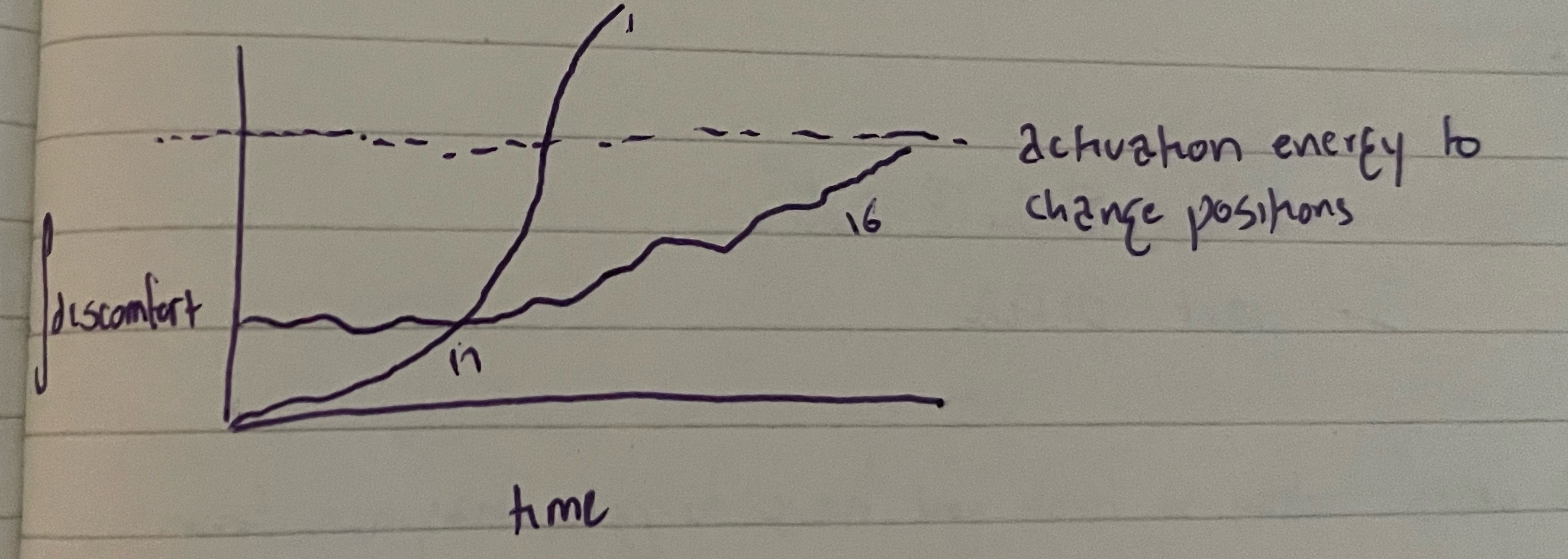
more or less, it seems that most construct their environments to provide a sense of comfort13. this is a mistake as it allows one to retreat to a least-bad option rather than one that is actively nourishing.
modernity is constructed in largely the same style. all actions require time and effort14; given that these are in short supply, we aim to minimize the unwieldy tasks. the dishwasher and stand mixer15 are two such marvelous inventions. other, more recent, innovations are more of a mixed bag.
a theme of the twenty-first century is instantaneity and convenience. physical tasks (laundry, cleaning, etc.) run into physical constraints as t–>0; in electronics, the minimum time to perform an action is below our comprehension16. anything non-physical is transformed into the electronic domain for our convenience. unfortunately, the way in which us humans differentiate ourselves is through a non-physical language.
problem: “i want pizza”
t - 10000 years: okay so first you have to get enzymes from the stomach of an auroch and bacteria from the air. then thresh and grind some wheat, then mix with water. also, wait for your cows to become pregnant and mix milk with the stomach enzymes, then strain the curds that result. while the wheat mixture is rising, build a boat and sail to america to get tomatoes. turn those into paste on the voyage back, then spread that paste on the dough before topping that with curds. fire it at 500F for 7 minutes.
t - 2000: walk to the taverna downstairs and pay ten denarii.
t - 1000: die of plague.
t - 300: see t - 2000.
t - 30: call the pizza restaurant and receive one on your doorstep an hour later.
t - 5: press a button on your phone. pizza arrives via drone.
one problem with the pizza scenario is that it reduces the pizza threshold below the optimal range. ordering a pizza costs more money and is worse for you than most home-cooked meals. by requiring one to go downstairs, talk to a person, etc., one must use some form of mental energy which allows them to reconsider. a button in the phone does not. furthermore, there are serendipities involved in going outside – meeting a person, enjoying the weather – that cannot happen if one is holed up inside. streamlining eliminates slim and invaluable opportunities.
worse, the entire social process exists in the realm of language. as new technology promises to save us time, it does so by cutting down on language exchange. why speak face to face with others17 when we can get enjoyment on demand.
problem: “i would like the satisfaction given to me by doing something”
t - 6000: i hit my brother in the head with a rock. G!d curses me,
t - 2000: i talk with family, go to the tavern, agora, etc.
t - 100: i listen to the radio and leave when bored.
t - 60: i watch tv
t - 30: i wait for my website to load and read it
t - 5: i view any one of the infinite opportunities for entertainment which live in my pocket
t = 0: i talk to chat gpt(???)
broadly, we are on a quest to expedite the satisfaction that we would otherwise obtain by interacting with others. first, we are replacing this face-to-face interaction which we do have with instantaneous communication through text and social media. skip the niceties and let me see your 2025 wrapped. second, these new entertainment possibilities provide a consistently positive (but small) reward as opposed to personal interaction, which is much higher variance.
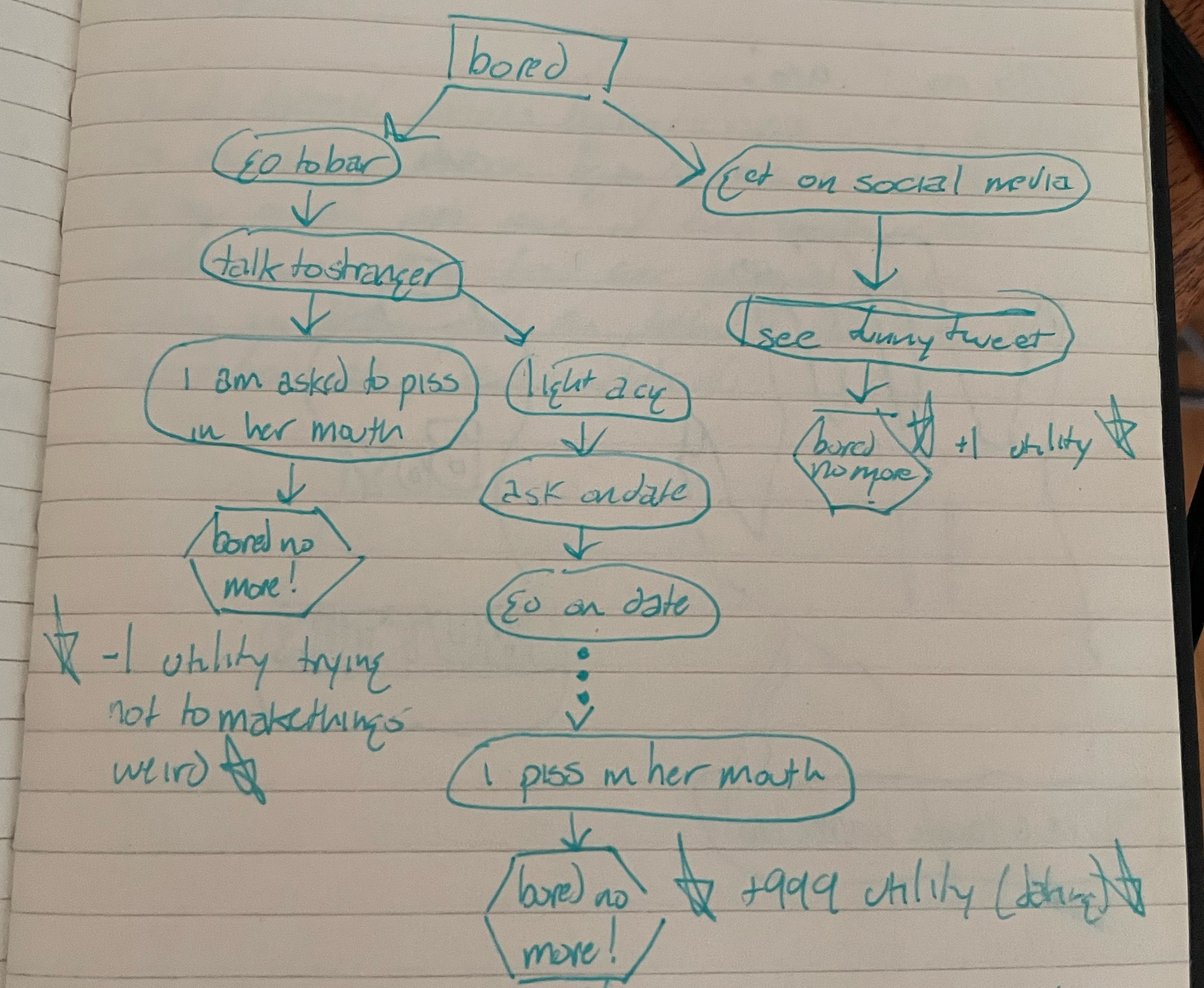
social media optimizes for small repeatable utility gains. given risk aversion, we find this optimal by eliminating the chances of a negative outcome. however, we reduce the overall gain of living full lives. i posit the following:
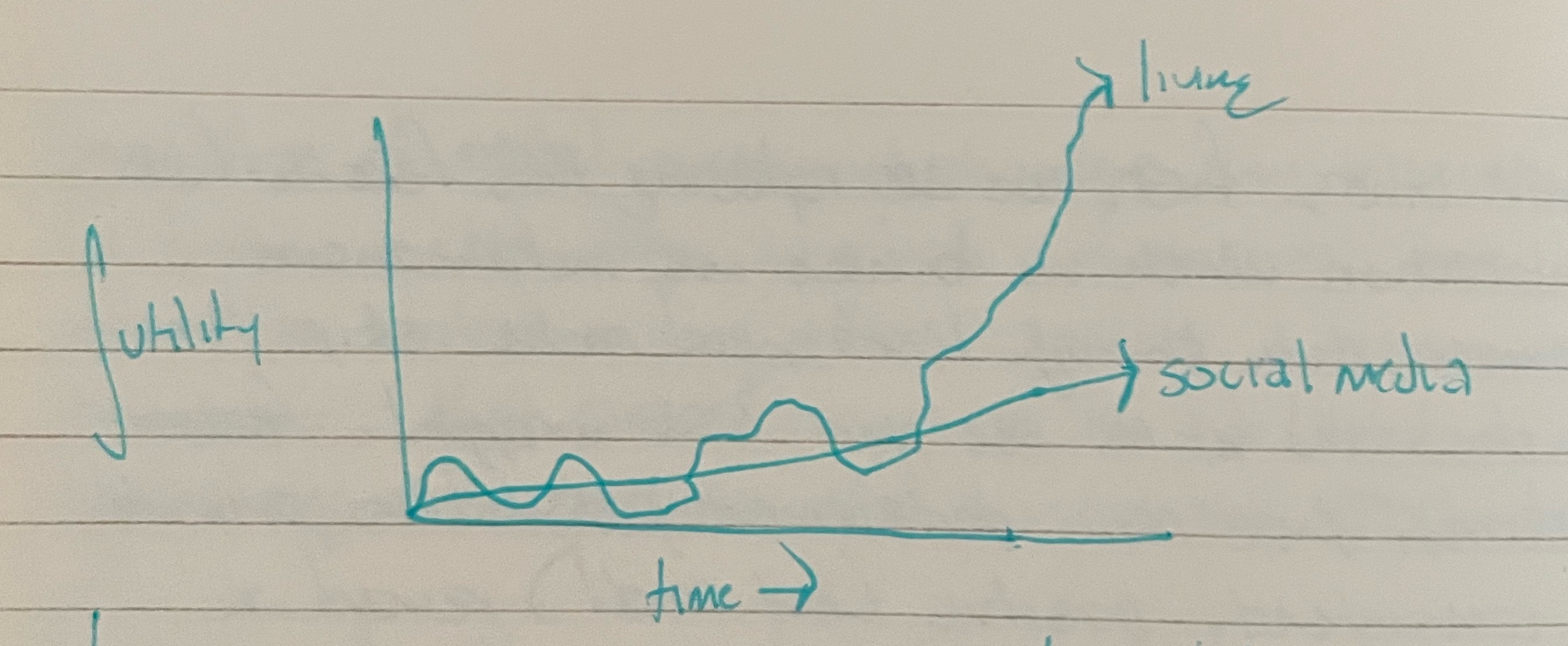
living via screen is no way to live. life ought to be less of a slip and slide and more of a corn maze.
-
commonly referred to as thanatophobia, or fear of death. ↩
-
in engineering terms, attempting to reduce t_(disliked tasks) to zero ↩
-
common among engineering-types. imagine the kind of tech worker who moved to san francisco in the mid-aughts. ↩
-
i have a vivid memory of going up to my transport professor after class, having spent the past two nights working on his problem sets, to ask whether twelve hours of homework per week was normal in his class. he thought for a second before telling me “yes” – what a relief to know i was an average student! ↩
-
a contention here may be that we do not have definite knowledge of the future. however, we do know statistics and history, and if one is to full commit to being-in-the-moment, they cannot discount the possibility that they will feel entirely different about any action they make from one moment to the next. ↩
-
a preference found in rural areas or the midwest, where vegetables seem to be boiled without spices ↩
-
though i can still say i enjoy food and dislike sleeping ↩
-
moments between google calendar blocks in which i stand, pace around the office, get a coffee, and so on. ↩
-
“shower thoughts” are a good example as one cannot easily have a phone or book in there, and so the shower-er must think ↩
-
calvin hammering nails dot jay pee gee ↩
-
that being said, having an environment comfortable for guests is necessary. ↩
-
or energy. for more, read energy and civilization by vaclav smil. ↩
-
making bread by hand should be a task that all bakers must perform such that we recognize what must have been the massive forearms of those who came before us. ↩
-
unless you’re performing some computationally-intensive task, such as running my 64MB excel file for calculating energy index prices. ↩
-
for most, i’d imagine that this provides some positive utility. however, among a subset of silicon valley computer nerds, social interaction is painful enough to merit a restructuring of our social landscapes. ↩
-
though this alone is not the end goal of life –> other qualities may be more important. ↩
-
i first got into running through this program in the summer before my eighth grade and have re-done it a few times since – the first bit will always be painful, but it always gets better too! ↩