effective anarchism
January 8, 2026
There is nothing inherently wrong with discussion—the recording of ideas, beliefs, and concepts then debate thereof is important in guiding one or many toward a central goal. As with all things, this sometimes runs in excess, especially in spaces predisposed to discursive norms with a rich textual background. In doing so, groups desiring to parcel out a solution run afoul of an often-forgotten constraint—time.
Effective altruists are prone to ask, “What is the most good I can do with my money?” proceed to do the math, and spend 10% of their income on malaria nets. Though I am not a strict utilitarian, I respect the calculating, efficient manner in which this business is done.
Left-ish (and more specifically, anarchist) groups are far more money-constrained than EA spaces, but spend a similar amount of time (if not more!) on internal debate. However, time is universally in short supply. As a result, we begin to conceptualize a framework best described as effective anarchism.
The central question of this framework is: “Given X amount of time, what is the most effective action I can do with my (statistically little) resources?” Given such a heuristic, debating “ideas” will nearly always place at the bottom. On a short timescale, the most effective constrained intervention will be directly assisting one or more people with needs (food, books to prisoners, etc.). A constrained medium term intervention would likely be getting together a larger group of people which may accomplish some local task (communication system, street safety, food/med distribution, etc.). Long-term interventions do merit additional discussion to coordinate group activities (i.e., food not bombs and DIY spaces) but meeting frequency and length ought to be kept at a minimum. All the discussion in the world is worth nothing if people are not being helped.
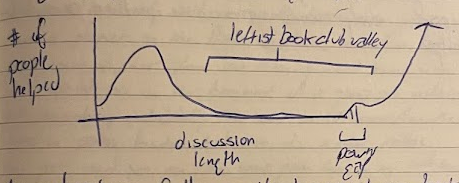
The implication of this is that anarchism best operates in the grey zone between government and private services (in the status quo). If we lived on Earth Two, where every business is actually a workers’ cooperative, this would be a different story. But we are not there yet. At the moment, the best constrained good we can do is that which fills the gaps between large, inefficient machines. Top-down structures do not know the specific needs of those around you, but you do. This local method is unquantifiable and invaluable to those seeking to effect change.

Other groups (i.e. local churches) recognize this already, running food pantries and clothing drives. Despite the decay of those institutions, anarchists (and other left-leaning groups) have the perfect opportunity to step in and help those who are otherwise falling through the cracks. It takes recognition that we have neither time nor resources in excess. Every second wasted is another person left unhelped.