energy balances
January 6, 2026
Chemical engineer voice: “Have you considered that everything is an energy balance?”
Given a person, we can convert their life into a basic energy balance. Dehumanizing, sure, but they will need to support biological activities with a caloric (or energy cost) of O, which is dissipated largely as heat (this is why people run at ∼98.6∘F and not ambient). To do so, one must consume at least an equivalent energy I in the way of food. These two alone suggest every individual eats exactly what they expend. Luckily, we store energy G in the way of glycogen, fat, and muscle, and may expend this later in the form C. Complicating this is that various processes within the body may detect these flows and vary the rate at which they expend energy accordingly.
As an example, I am currently 5′5′′ and ∼118 lb. At this height and weight, one would expect me to burn ∼1500 kcaal/day by virtue of existing. Additionally, I enjoy running, which transforms additional energy into heat (if you doubt this, try running in 16∘F weather and walking, then compare the differences in sensation!) at a rate of ∼800 kcal/day. However, I struggle to eat 2300 kcal/day. Naively, one would expect me to lose weight (and I have lost a bit). However, given that I do not weigh 80 lb at the moment, something else must be happening.
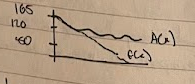
In actuality, the body shifts other processes to compensate. I tend to run a little cold; for a time my fingernails stopped to grow, etc. (yes, this is bad). In other words, the body system modifies its rate of accumulation and consumption based on its input and output.
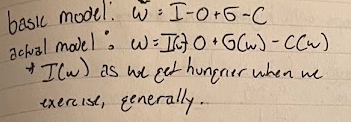
If you prefer a graphical explanation:
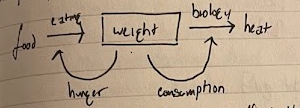
There are more variables which affect these flows, but let’s keep it simple for now.
Scaling up, a group of people must require ∑I energy to function at ∑O outputs. This likely scales linearly as one does not burn a different amount of calories in the presence of varying levels of people. Thus, any group must increase production of nutrients as its population grows. It follows that nutritional availability limits population size.
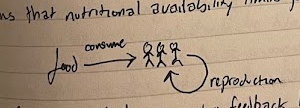
Is there a negative feedback loop between population and dP/dt? (think of an example)
Given that this production consumes a diminishing amount of resources (land), any growing population either requires more land or a higher energy density per unit land. If this is true, we would expect areas with the highest historical (not considering nutrient availability and the effects of modern trade) population density to have either large areas of adjacent farmland or crops with higher caloric density.
The table below shows the calorie density of several crops:
Crop,kcal/acre Soy,6.2 Sunflower Seeds,4.38 Wheat,1.1 Peas,3.3 Black Beans,2.67 Lentils,2.2
I don’t really have a conclusion here; it’s just cool that everything is modelable as an energy balance (note, one can look at population and civilizational progress). If you want a deeper look, read Energy and Civilization by Vaclav Smil.